VEITH Pin Table for knitted fabric
Tubular fabric — open width
This particular VEITH Pin Table is designed in order to support the spreading and matching of knitted fabrics with horizontal and with inclined stripes, i.e. it supports yarn dyed fabric as well as printed fabrics. Together with the VEITH PinIT software it forms a strong team to improve fabric utilization and productivity.
The Problem
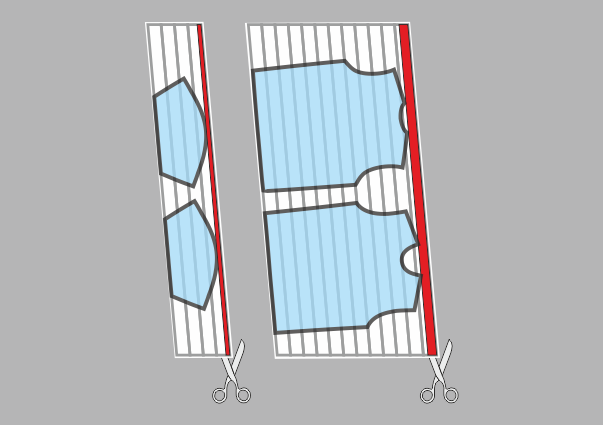
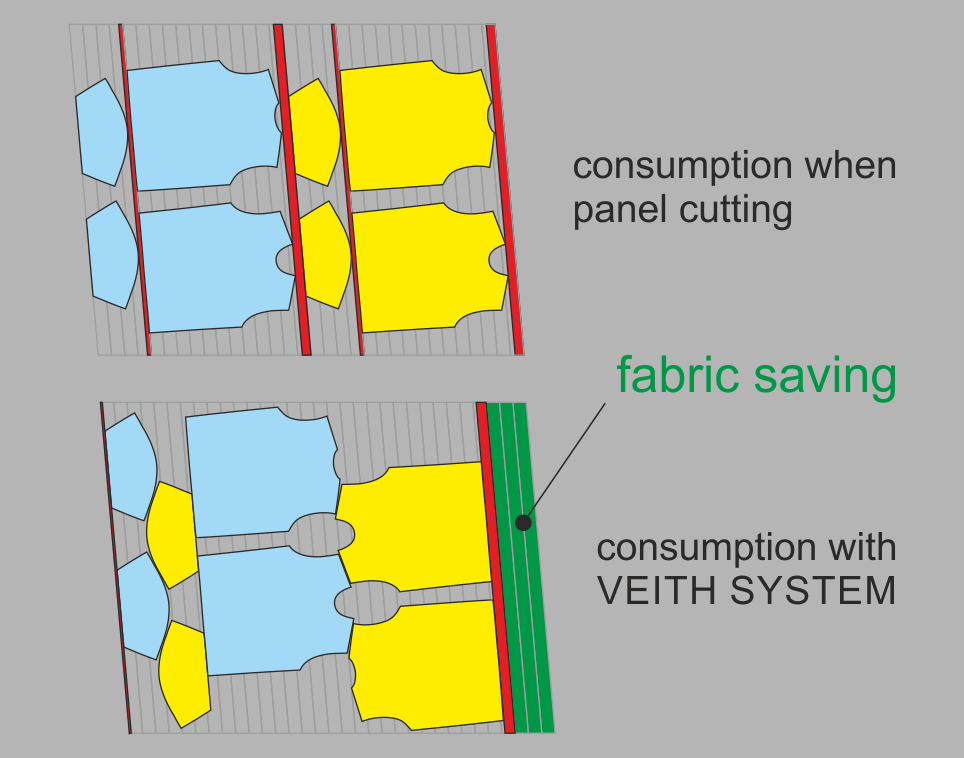
Typical traditional panel cutting
red area: lost fabric
- Matching stripes in knitwear has always been difficult and time consuming due to the nature of the material.
- Knitted fabrics are manufactured in a circular process creating a spiral. Opening the tube leads to fabric with inclined stripes — typical for yarn dyed fabrics.
- As slanted stripes would mean to work in a slanted coordinate system, it is often tried to manipulate the orientation of the stripes towards a more vertical direction. This happens typically when stentering or compacting the fabric. Unfortunately this manipulation of the fabric structure often leads to bowing or wavy stripes due to wrong process parameters.
- Traditional methods for matching tend to waste a lot of material, since the fabric is cut in panels or patterns have to be cut out with blocking tolerances.
- The task of re-arranging the blocked pieces is time consuming and so expensive.
- The operators doing the matching job have to be skilled and experienced, because of the elastic nature of the fabric.
The Solution
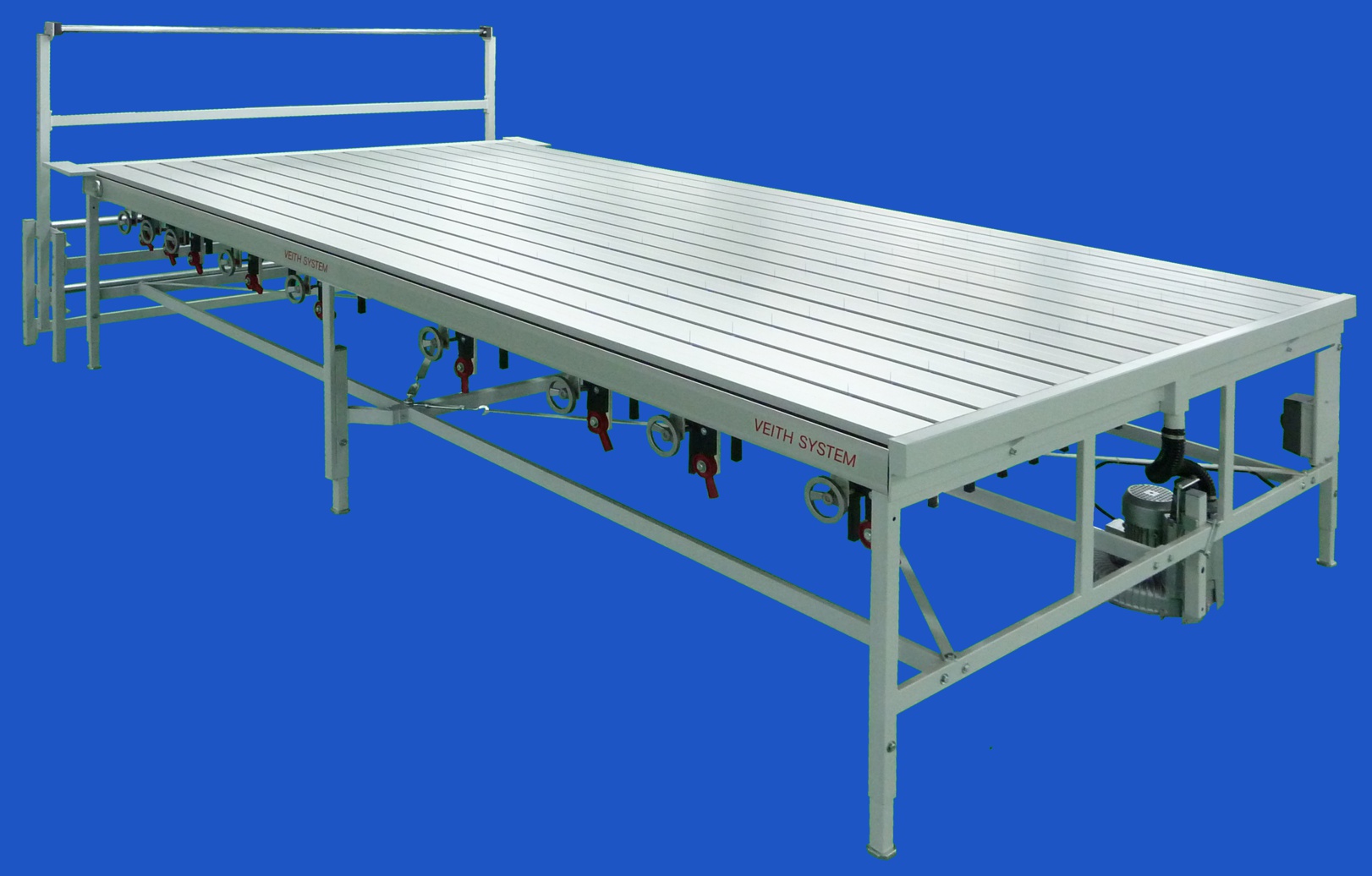
VEITH Pin Table
for tubular knitted fabric — open width
Shown options:
- VEITH Roll Stand
- air flotation system
- The patented VEITH Pin Table for knitted fabrics is based on the standard model of the VEITH Pin TABLE used for woven fabrics.
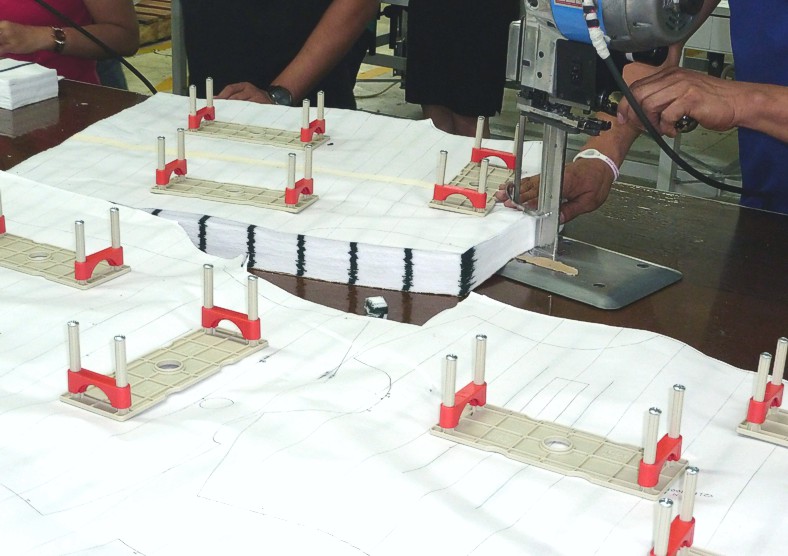
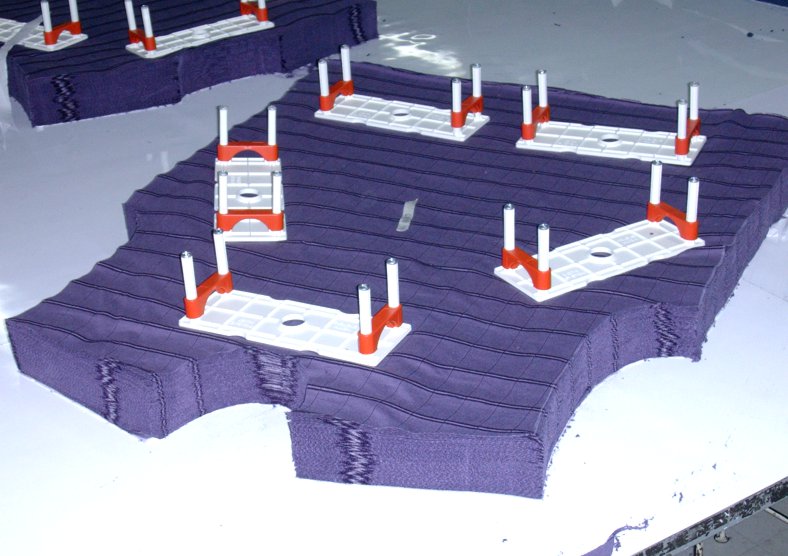
- It has a lengthwise slotted aluminum top.
- The pins are positioned inside the slots.
- The pins are carried by needle bars underneath the table top going across the table and creating always a line of pins.
- The design of the VEITH Pin Table allows to position the needle bars lengthwise at any required position.
- A special feature of this VEITH Pin Table for tubular knitted fabrics (=fabrics with slanted stripes) allows that the needle bars can be turned up to an angle of 13 degrees — this in addition and at the same time to the random lengthwise positioning feature.
- Once a needle bar is set and turned to a particular position it can be fixed to this position by a brake mechanism.
- The needle bar positions can be adjusted, even when spreading and matching of the fabric has already started. This allows to overcome problems with too much tension or with too much looseness.
- The height of the pins can be adjusted by turning a hand-wheel. So spreading and pinning the fabric becomes easy, convenient and fast, and avoids tension in the lay package.
- Each pin can be individually locked down, i.e. only the minimum needed quantity of pins have to be used.
- VEITH SYSTEM uses special manufactured pins with a rounded tip (ball point), which are avoiding damages to the fabric. So the pins do not have to stay in the waste area of the fabric, but can be used also inside the panels. I.e. matching and the quality is created inside the pieces, where it is required — not somewhere outside in the waste.
All these features make this VEITH Pin Table to a tool, which can be used in a very flexible and universal way. It is especially designed to deal with the difficult nature of tubular knitted fabrics spread in open width. It supports yarn dyed fabrics as well as printed fabrics.
Advantages
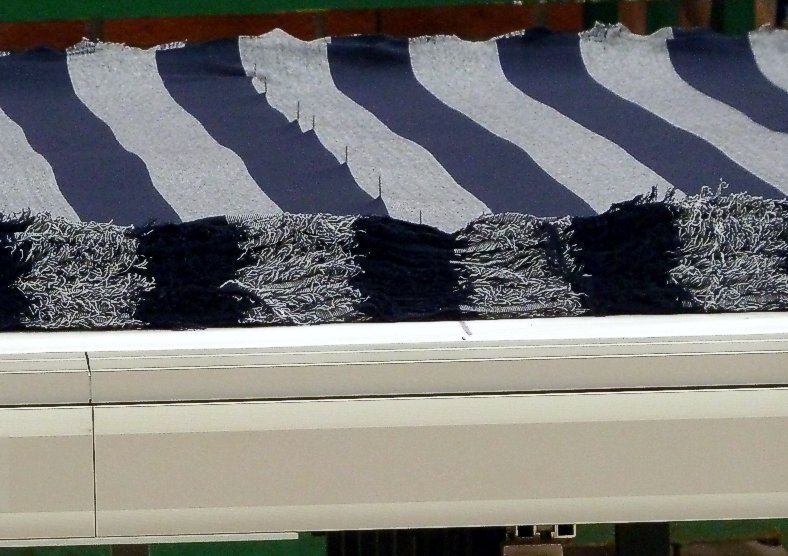
- Improving the quality
- Spreading and matching in one combined step
- Avoiding of relaying operations
- Reducing the fabric consumption
- Quick setup time
- Flexible system, which allows to adjust needle bar positions even after having started spreading, i.e. it allows to react on too much looseness — or — to react on too much tension (fine tuning)
- Immediate fine cutting (net cutting) after spreading — no relaying
- Preparing the lay package even for CNC-Cutting (if certain preconditions are fulfilled)
- Implementing clear top-down organization for spreading and matching of checked (plaid) and striped fabrics — high efficient engineered industrial process — from fabric registration — through marker making — through spreading and matching — until cutting
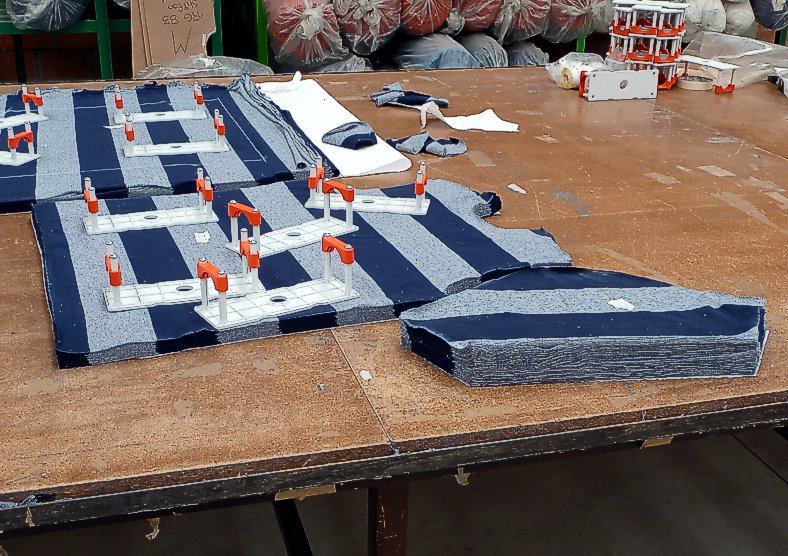
Know-How
Know How is the key to success. VEITH SYSTEM is not delivering just an isolated piece of hardware, but we offer our specific Know How and additional required tools, such as the VEITH PinIT software. The VEITH Pin Table is a part of a complete matching solution — the VEITH Matching Solution.
- Our Know How is based on the experience of more than 900 installations world wide.
- Successful matching has a lot to do with correct marker making. Therefore marker making was always a key subject for us, when helping our customers with the implementation of a matching process.
- We have developed a method, which allows for the first time to plan matching markers for fabrics with slanted stripes, i.e. for typical yarn dyed tubular fabric — being spread open width. These markers can be planned using a normal professional CAD-software. The VEITH PinIT software is required to work according to this method.
- There are particular rules and restrictions to observe during planning markers for matching. These rules and restrictions depend on the application and matching requirements.
- Our concept of marker making reduces the problems of repeat variations.
- Our way of planning markers allows to follow various strategies to arrange patterns in the marker for a better utilization of the fabric.
- With a VEITH SYSTEM marker it is possible to cut stripes even on a CNC-Cutter, provided certain preconditions are fulfilled.
Our Know How will make sure to implement an industrial organized matching process — a process with a clear top-down structure very much similar to the process used in case of solid fabrics. In case of Polo-Shirts this process will follow the steps listed next.
Process Steps
- measuring the fabrics
- registration of the fabrics in VEITH PinIT
- pre-process of marker making in VEITH PinIT, i.e. generating certain key data required for marker making
- planning the marker on a professional CAD System
- work preparation for the usage of the VEITH Pin Table using VEITH PinIT
- setting up the VEITH Pin Table according to the before determined data
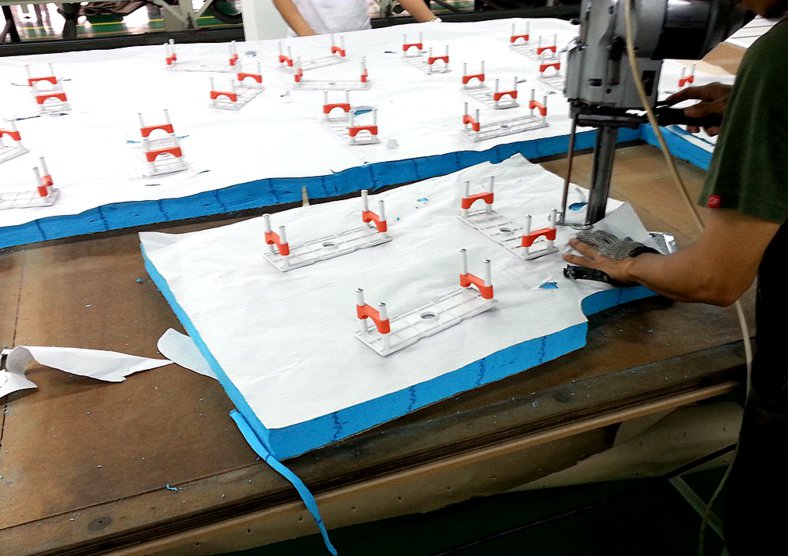
- spreading and matching the fabric ply by ply in a combined work-step using the VEITH Pin Table
- net cutting of the matched lay package
More detailed information about the complete process can be found on ourVEITH PinIT page.
Know How or knowledge makes the difference. Only with sufficient knowledge it will be possible to drop blocking or get away from typical panel cutting. With the data generated by the VEITH PinIT software it is possible to plan matching markers for fabrics with slanted stripes on a normal CAD software, i.e. for typical yarn dyed fabric. It is the only way to do it, because normal CAD software is working only in a perpendicular logic. Proper marker making is the precondition for a substantial reduction of fabric consumption. Our Know How and our tools are helping our customers to get there.
This is the key aspect in a situation, where the fabric costs are representing the majority of the manufacturing costs — often 60–70%. This is what counts. Other advantages — like reduced labor time — are then reduced to a highly appreciated additional benefit.
Savings
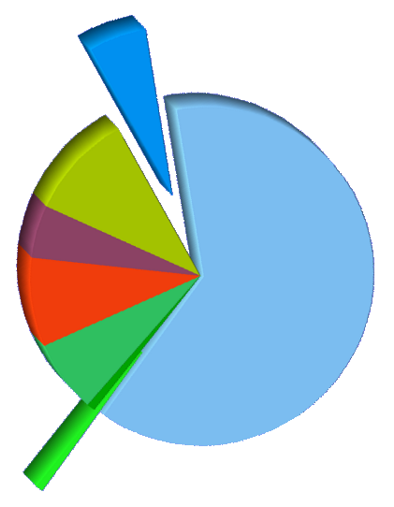
- Fabric savings (blue) in the range of typical 5% to 10%
- Labor saving (green) between 30% and 50%
- Easier control of the process of spreading and matching
- The demand in the skills of the operators is less.
- This results in a ROI of normally less than 9 months.
- Even the ROI of a CNC-cutter can be reduced.
Technical Data
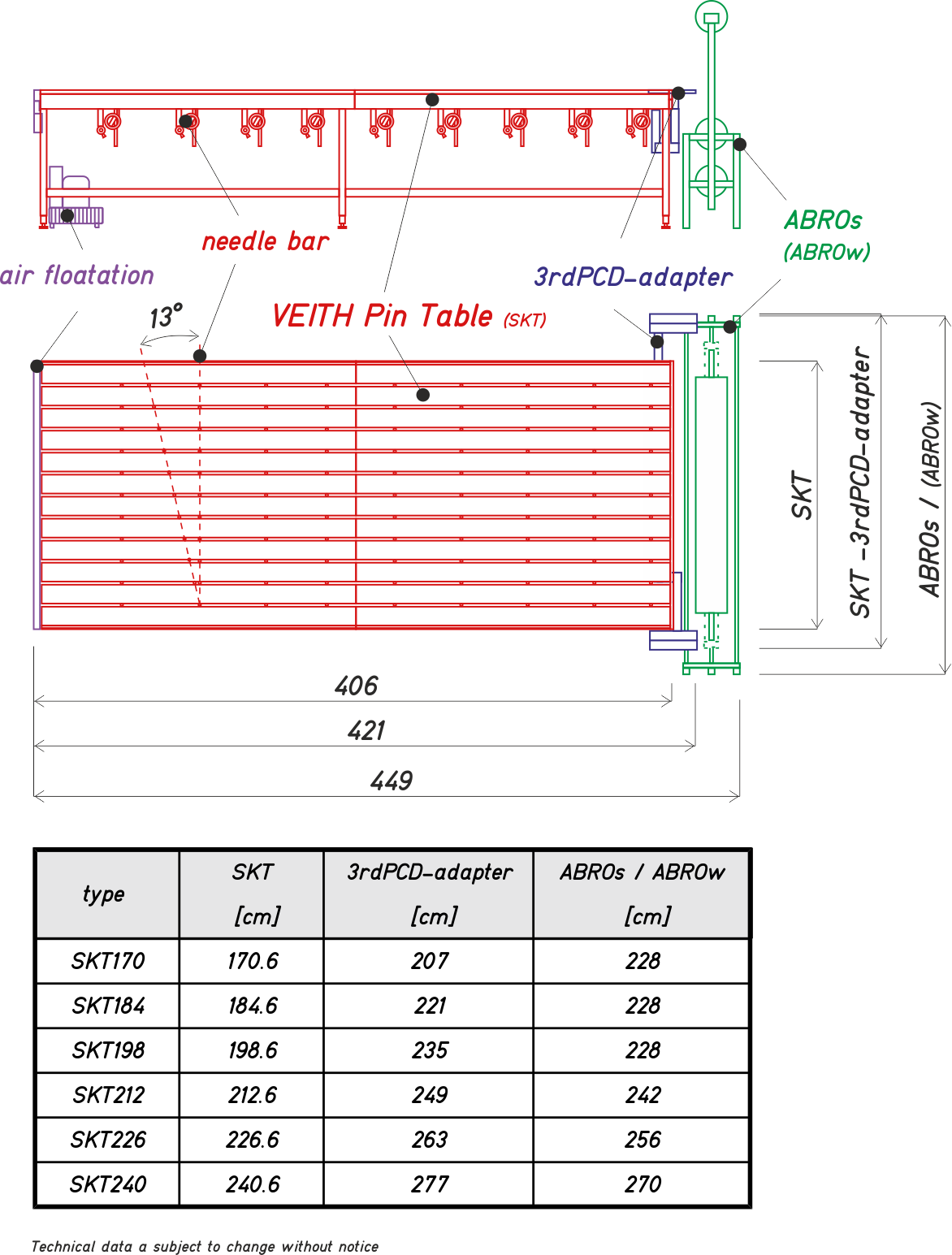
VEITH Pin Table — SKT-type
- Size of standard VEITH Pin Table (for tubular knitted fabrics — open width):
- length: 406 cm
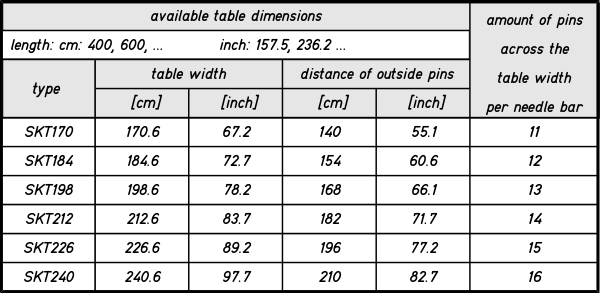
- width: 170–240 cm — mostly used 212 cm
- height adjustable: 80–90 cm
- Available widths: 170, 184, 198, 212, 226 and 240 cm
- Table length adjustable with 2m modules
- Needle diameter is colour coded — all needles with rounded tip (ball point):
- needle diameter 1.0mm (blue)
- needle diameter 1.4mm (green)
- needle diameter 1.8mm (red)
- Length of standard needle — 10cm. Note: this does not mean that a lay package can be spread up to 10cm, there are other limiting factors such as the stability of the needle due to its diameter.
- Other special available needles (handmade):
- extra fine needle — diameter 0.6mm, length 25mm
- needle with eye — diameter 1.7mm, length 30mm
Options
- VEITH Needle Plates (STOLK)
- VEITH PinIT Software for the VEITH PIN-TABLE
- VEITH Roll Stand or VEITH Turn Table with extra device for underlay paper and polyethylene film
- Air flotation for easy transport of heavy lays
- VEITH adapter for 3rd party cutting device (end cutter), following actual used angle of needle bars
- Additional VEITH Needle Bars
- Belt-drive for automated transport
VEITH Solutions for Special Applications
- VEITH Pin Table for woven fabrics
- VEITH Pin Table for flat knitted fabrics
- VEITH MDflex, pinning system for lace
- VEITH Symmetric Matching Device
- VEITH Linear Matching Device
In case of handling multiple cloth rolls with plenty exchanges of cloth rolls for managing split spreading orders (e.g. MTM):VEITH Cloth Roll Magazine with integrated Gantry Spreader
Example Application
See the polo shirts examplefor a detailed demonstration of the matching process with yarn dyed knitted fabric.
Brochures
More brochures available on our brochures page.